To put it briefly, Internet speeds in the 100–200 Mbps range are ideal for most households since they can handle common uses similar streaming and video conversation for 2–5 users at once. All the same, there are a number of factors that should also be considered — especially for use cases similar habitation offices and gaming, where upload capacity for files and reaction time for user actions is particularly important.
Along with upload speeds, latency, and your location, some other factor to consider is your WiFi network. The average WiFi speed yous experience around your home will more often than not be anywhere from 20–50% beneath the advertised download speed, due to wireless interference and fade equally y'all move farther from the router. With that beingness said, it's of import to choose a speed slightly faster than what you need to business relationship for network slowdowns.
While each household will accept their own definition of what a good cyberspace speed is based on their needs, here are a few elementary guidelines on different speeds and what they can handle:
| Internet Speed | Users Supported | Speed Summary |
|---|---|---|
| 25 Mbps | i-2 | Basic |
| 100 Mbps | 3-iv | Average |
| 200 Mbps | four-v | Fast |
| 500 Mbps | 5+ | Very Fast |
| 1000 Mbps | five+ | Gigabit |
To get a quick recommendation based on the number of users and devices in your home, take a look at our bandwidth adding tool. If yous already have WiFi and are having slower than normal speeds, try troubleshooting your WiFi ,or consider learning how to extend your WiFi network.
In this commodity, we will aid you lot to determine how much cyberspace speed you need based on how many internet users are in your home and how they use the internet.
Mbps stands for "Megabits per 2nd." This is the standard measure out of "speed" or "bandwidth" on habitation internet connections. It measures how many bits (units of digital data) tin can be transferred each second. Yous'll commonly see speeds ranging from ten–i,000 Mbps advertised for domicile internet plans.
How Much Speed Practise I Really Demand?
Hither are some general download speed requirements based on everyday online activities:
- Check electronic mail and browse the spider web: 1-five Mbps minimum
- Stream HD content: fifteen-25 Mbps minimum
- Stream 4K content and play competitive online games: 40-100 Mbps minimum
- Stream 4K content, play online games, and download very large files: 200+ Mbps minimum
What is a Skillful Cyberspace Speed?
Any internet connection above 25 Mbps is a good internet speed. The FCC currently defines a "broadband" cyberspace connection as one that provides at to the lowest degree 25 Mbps for download speed and 3 Mbps for upload. This is a decent benchmark for the average family of three; however, larger households of three-5 people should consider speeds closer to the 100–200 Mbps range.
In gild to be a "skillful" internet speed, the connection has to meet the needs of the household, which will vary based on number of devices continued and how many people use the connexion at once.
The experience using an internet connection depends on several factors:
- How many devices are continued and in use simultaneously?
- How many people are streaming video from Netflix, YouTube, or some other service?
- Are you using your home WiFi for competitive online gaming?
- Do you frequently need to send large files for piece of work?
- Do you regularly stream 4k video, or do y'all more often than not stick to simple online tasks?
- Practice yous become frustrated easily if your game lags or your webpage takes a while to load?
Equally you can see, good internet speed tin mean something different for every household. For instance, if you are using your home WiFi for cypher only spider web browsing and e-mail, you might feel that yous accept fast internet with only 10 Mbps.
On the other paw, someone who streams 4k video on multiple devices, plays video games online, and has smart home IoT devices, may non exist satisfied with even 100 Mbps. They should look at cobweb options like those offered past AT&T Fiber or Frontier FiberOptic which offers higher uploads speeds than other mutual connections like cable and DSL.
It'due south worth mentioning that the range of functioning you can get is somewhat relative to your location. Rural areas in states similar California and even New York frequently accept much lower speeds (around 25 Mbps) and fewer options, when compared to urban centers inside the state which typically accept 100+ Mbps plans available, such as Los Angeles, San Diego, or Brooklyn.
What is a Fast Cyberspace Speed?
By most definitions, anything to a higher place 100 Mbps is considered "fast." Once you start getting close to 1000 Mbps, the internet plan is called a "gigabit" service.
If y'all're wondering why anyone would e'er need a chiliad+ Mbps download or upload speed, the reply is pretty simple: most of united states don't (though that may modify in the future). That said, these sorts of speeds may be worth it for techies, gamers, streamers, and large households.
What Is the Difference Between Upload and Download Speed?
If you don't know the difference betwixt upload and download speeds, here is a elementary breakdown:
- Download speed: how quickly your Cyberspace connection can think data from the Internet (web pages, video, cat photos, etc.)
- Upload speed: how quickly your Internet connection can send data from your devices up to the Internet (uploading video to YouTube, sending documents via email, etc.)
When y'all run across the advertised speed of an internet plan, what you lot ordinarily run across is the download speed. Ofttimes, the upload speed isn't visible at kickoff, or it appears in a much smaller size at the bottom.
Download speed is much more important for the average user, since you lot just notice upload speed when trying to share big files. Information technology is normal for your upload speed to be around one 10th your download speed. However, fiber internet users often take symmetrical (or identical) download and upload speeds.
How Fast is 25 Mbps?
A 25 Mbps plan can be referred to as the "Goldilocks" of internet plans. It is neither too fast or too boring. For a small household of light cyberspace users, you won't suffer from frustrating lag or exist paying for bandwidth that you don't need.
Here are some things you can expect from 25 Mbps:
- Stream Netflix and YouTube at 1080p on one or two devices without buffering
- Play almost online games without lag
- Almost zero wait time for loading most webpages
So, is 25 Mbps fast?
For a minor household that isn't doing intense streaming on multiple devices or gaming at high-resolution, 25 Mbps is relatively fast. For larger households or for internet users that need 4k resolution, 25 Mbps may yet not be enough. The biggest factor hither will exist the number of devices being used at a fourth dimension. Almost whatever household tin get away with 25 Mbps as long every bit the number of users/devices online at a fourth dimension is limited. For example, 3-4 people could stream in HD with a 25 Mbps connection, but anyone else trying to get online will likely feel a slow connection.
All-time Internet Speeds For Streaming

Basic streaming does not crave very much bandwidth. However, when you commencement to stream in 4k resolution or stream on many devices at one time, you will need a much larger net bundle.
How Much Internet Speed Practise I Demand for Netflix?
In general, streaming video on platforms such as Netflix or YouTube Television receiver requires 3-5 Mbps to stream in HD.
If you lot want to stream in 4k Ultra Hard disk drive, yous will need a minimum of 25 Mbps. Even so, streaming even one video in 4k Hard disk may apply upwardly all of your available bandwidth. For that reason, if you like high-definition video and you lot accept more than one device connected at a fourth dimension, we recommend a speed of 50 Mbps or more.
For example, say you have a 25 Mbps downwards connection speed. If the total chapters of your internet connexion was a pie, each device on the network gets a "slice."
Your total potential speed is split across all of the devices continued to the network. So, a 25 Mbps plan may only be providing 10-15 Mbps to Netflix — depending on how many devices are taking a "slice."
Besides, using WiFi will always be slower than a hardwired connection. Trying to stream over WiFi can produce less-than-stellar results.
Thankfully, in that location are a few things you can do to ensure that yous're maximizing your chances of a trouble-complimentary streaming experience:
- Connect your streaming devices to the router with an ethernet cable whenever possible.
- When streaming over WiFi, position the streaming device equally shut to the router as possible, with no physical barriers similar walls or furniture between them. This will aid yous achieve a more stable connection.
Use our bandwidth calculator to get an gauge of the speed you really demand to stream on multiple devices at home.
Best Internet Speed for Gaming
Online gaming is 1 of the few activities that require a fast upload speed. This is because the deportment that you perform in-game are uploaded to a server for other players to view and collaborate with.
How Much Internet Speed Practice I Need for Gaming?
Minimum internet speed requirements for gaming are usually four-eight Mbps if nobody else in the house is using up your bandwidth. Unfortunately, slower internet plans such as these may not give y'all the upload speed y'all need for a consistently skilful experience.
If y'all are the only ane at home, a 25 Mbps internet plan is recommended for smooth gaming. Yet, speed isn't the only thing that matters in gaming: ping and latency play a office as well.
Ping and Latency: Does It Matter?
Latency is a measurement of the amount of time it takes for information to be transmitted from 1 point to some other. Ping is oftentimes used interchangeably to describe this, but in fact, a "ping" is simply the act of hailing a certain receiver. Under this definition, latency is a measurement of how apace y'all tin "ping" the server you are trying to reach.
And then, is latency a real business concern when deciding which service provider to choose from?
Honestly, the majority of users will likely not be impacted by latency. Latency is more of an issue for satellite net users as it takes longer for data to travel and is more susceptible to interference than wired internet connections (i.e. cablevision, DSL, and fiber). Competitive gamers serious near getting the all-time connexion will definitely want to look into minimizing this number by either upgrading to a cable or cobweb internet connection or connecting their gaming device directly to their modem/router.
Mbps vs Gbps: What'southward the Difference?
Net speeds are measured in "Megabits per second," often abbreviated as "Mbps." These normally range anywhere from 1 Mbps up to 1000+ Mbps.
- One Mbps: 1 Megabit per second
- One Gbps: one Gigabit per 2d, or one 1000 Megabits. (1 Gbps is the maximum for most home Internet plans, and then yous will ofttimes run into cobweb providers advertise "gigabit service" or "gig speed.")
An average mp3 song in your iTunes ranges from 3 to v megabytes, whereas a 4K movie or television show can be several gigabytes, so it'due south of import to estimate the types of speeds y'all'll need appropriately.
Bits vs Bytes
The amount of data you use is measured in "bytes," while the speed you can motility data is measured in "$.25." For example:
"The boilerplate cable Internet plan has a download speed of 150 Megabits per second (Mbps), and a data cap of 1024 GigaBytes (GB)."
MB vs GB: What'due south the Difference?
This is disruptive for non-techies, only to put it simply:
- MB: MegaByte (a meg bytes of data)
- GB: = GigaByte (a billion bytes of data)
Yous volition likely run across the term GB used in conjunction with data caps, which some providers utilise to limit the amount of data you tin consume. These can either be difficult capped (service is not available after exceeding the stated corporeality) or soft-capped, meaning you volition simply experience slower speeds — and potentially, additional charges.
Why Does Internet Speed Vary Per Location?
Y'all may observe a certain visitor offering fast speeds in the subdivision adjacent yours…
…only to search your cyberspace options and observe they can't provide the same speed for your street.
This can be frustrating.
Regardless of which type of service you are interested in, your concrete connection has to get somewhere key before it tin can motility on to the wider network that forms the courage of the internet. For DSL and cable, this cardinal location is the provider'due south role or joining node, and for fiber, a central switch.
No matter the specifics, the physical distance between your home and these coming together points tin can have an impact on the speed of service a particular visitor is able to offer. Remember, though — but because i provider can just offer a sure speed, that doesn't necessarily mean all of them are limited in the same way.
If you alive in an area where in that location are several services to choose from, check the speeds offered by other ISPs in your area earlier setting an install engagement.
How Can I Calculate My Upload and Download Speed?
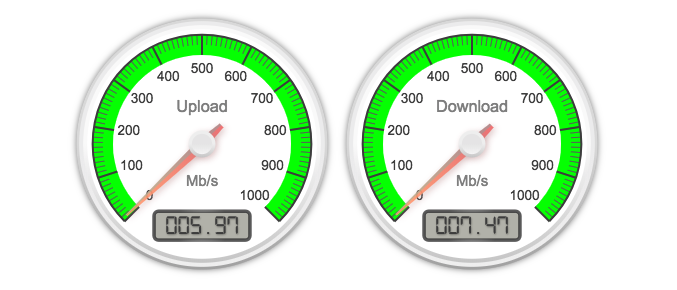
If you lot already have existing service merely aren't sure how fast it really is, you can find out using our speed test tool.
Essentially, this service works by sending exam samples of data to various remote servers, the same way yous would when browsing the web.
We then display the average upload and download speeds of those individual pieces of data, allowing y'all to get a good thought of what you're working with.
The Lesser Line: 25 Mbps Is the Minimum Speed for Modern Households
So how much speed practice y'all demand? If you don't have time to dig into the details, just brand sure you get a plan with at least 25 Mbps download speed. For nearly people, this is "good enough."
However, plans are constantly changing, sometimes offering faster speeds for lower prices. We recommend getting the fastest plan your preferred provider offers under $100/month — specially since information technology's possible to go gigabit fiber internet for only $lx-$lxx/month.
For more than detailed recommendations based on your specific household size and number of devices, visit our Internet speed calculator.
DOWNLOAD HERE
Posted by: suttonnibeshe.blogspot.com
Post a Comment